By clicking “Accept”, you agree to the storing of cookies on your device to enhance site navigation, analyze site usage, and assist in our marketing efforts. View our Cookie Policy for more information.
Icon Rounded Closed - BRIX Templates
Insights

Agent Inventory V2 Lands: What the Copilot Agent Kit September 2026 Release Means for Governance

5 mins
share on
Agent Inventory V2 Lands: What the Copilot Agent Kit September 2026 Release Means for Governance

The Copilot Agent Kit September 2026 release (the free, open-source Power CAT add-on formerly called the Copilot Studio Kit) ships Agent Inventory V2 on a faster Code App architecture, extends governance coverage to GitHub Copilot Harness agents, and adds relationship metadata: MCP lists, connected agents, evaluations, and agent owner IDs.

For CIOs and Power Platform teams, this closes real visibility gaps: you can finally see who owns each agent, what it connects to, and where consumption and risk are building up before agents scale past your guardrails.

What shipped in the Copilot Agent Kit September 2026 release?

Microsoft's Power Customer Advisory Team (Power CAT) shipped the September 2026 release (now branded Copilot Agent Kit, the rename of the Copilot Studio Kit). It remains a free, open-source Power Platform solution that complements Copilot Studio with testing, analytics, governance, and reusable components. The governance-focused highlights: 

  • Agent Inventory V2 rebuilt on a Code App architecture with better performance, cleaner UX, richer governance insights, advanced usage analytics, and component visualization. 
  • GitHub Copilot Harness coverage so Agent Inventory now discovers and governs reasoning-heavy harness agents, not just standard-harness ones. 
  • New relationship metadata: MCP lists, connected agents, evaluations, and agent owner ID per agent. 
  • Agent Review Tool version history to compare assessments across published versions. 
  • Agent Debugger redesign: session selector, advanced transcript filters, feedback visibility, and jump-to-slowest-step.
  • Agent Change Tracker audit-history analytics and search-by-username.
  • Advanced Testing: Adaptive Card validation now supports a Contains operator, plus a batch of bug fixes.

If you still frame agents as a low-code side project, start with why Copilot and agent governance fails without an operating model.
What is Agent Inventory V2 and why does it matter?

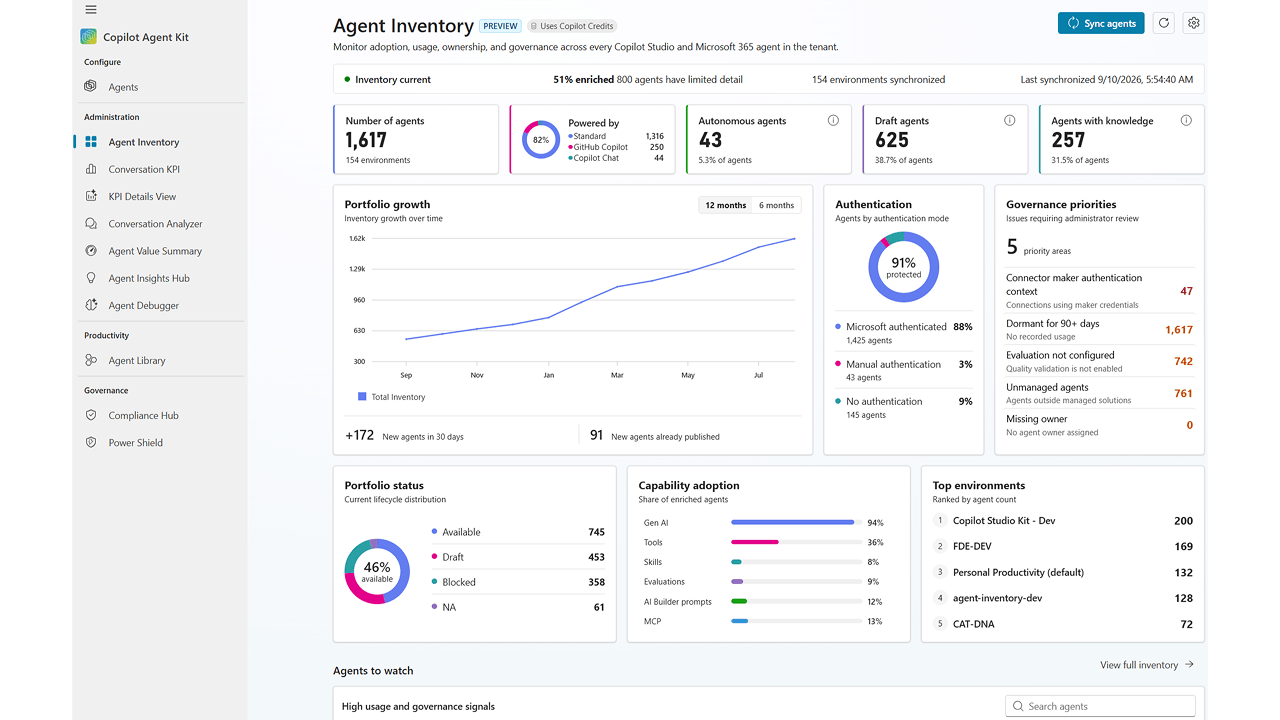
Agent Inventory V2 dashboard in Copilot Agent Kit
Agent Inventory V2 is a tenant-wide, cross-environment catalog of every Copilot Studio custom and declarative agent, rebuilt on a Code App architecture for speed and richer governance analytics. It matters because you cannot govern, fund, secure, or retire agents you cannot see.

The value is a single, exportable source of truth: lifecycle and ownership metadata, capability-adoption signals, authentication distribution, governance priorities needing review, and portfolio growth across 6 and 12 month ranges.

The first run is uncomfortable by design: it exposes ownerless agents, over-permissioned connectors, and duplicated builds that were invisible before.

That inventory becomes the backbone of an Agent PMO and a repeatable Copilot governance model, not a one-time cleanup. Field-level detail lives in Microsoft's Agent Inventory documentation. 

Why does GitHub Copilot Harness governance coverage matter now?

In Copilot Studio, a harness is the runtime that decides when to call the model and which tools to use.

The GitHub Copilot harness is the reasoning-heavy option: it takes a goal, breaks it into steps, calls connectors, knowledge, MCP, and connected agents, and bills against Copilot Credits.

Critically, makers can consume credits while building, previewing, and evaluating agents, before an agent ever reaches production.

That is the cost-governance trap: a maker-exploration environment can run up consumption even if nothing is ever published. By extending Agent Inventory to GitHub Copilot harness agents, this release lets you find them, classify environments as maker-development or funded-production, and apply the right controls.
What do MCP lists, connected agents, evaluations, and owner IDs tell you?

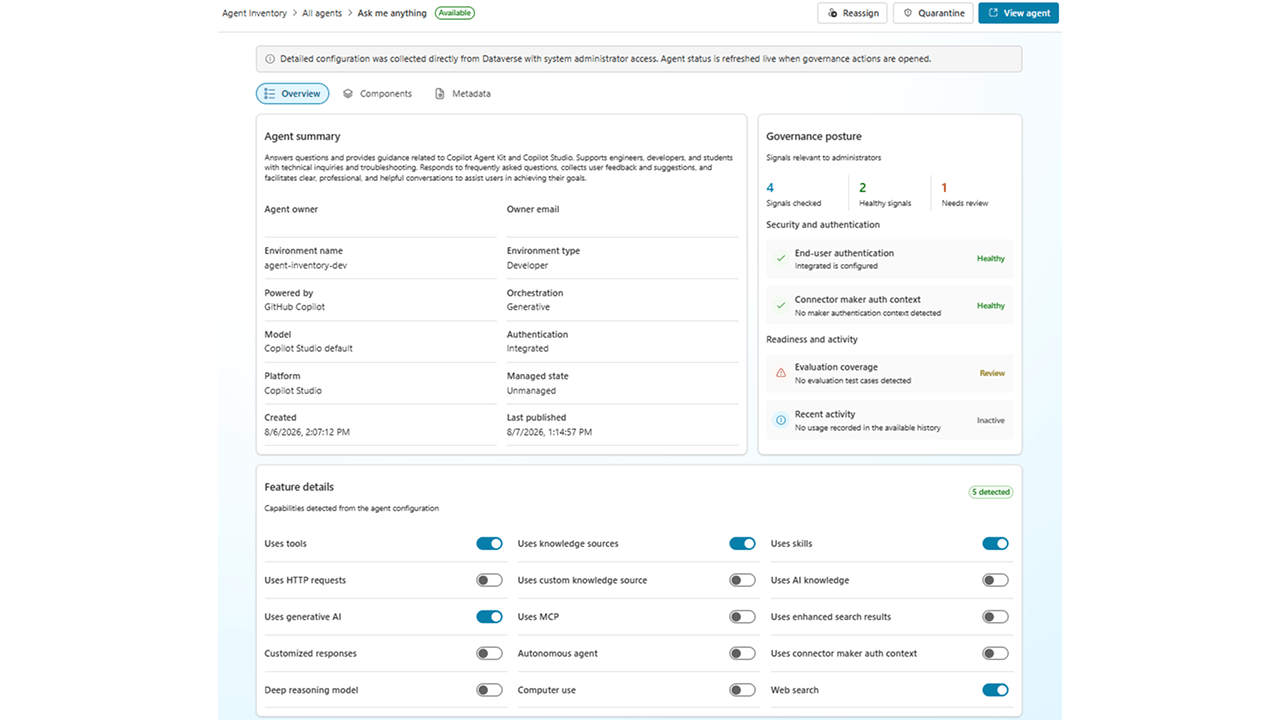
Agent Inventory V2 dashboard showing an agent's summary

The new metadata turns a flat list into a governance graph: 

  • MCP lists which Model Context Protocol tools an agent can reach (your data-egress and oversharing surface).
  • Connected agents which agents call which (blast radius in multi-agent orchestration).
  • Evaluations whether an agent was tested against quality and safety criteria.
  • Agent owner ID a named, accountable owner; no owner is itself a finding.

These map to the security questions in Microsoft Agent 365 for business leaders and the layered trust model in building trustworthy AI agents with Azure AI Foundry.

Agent Inventory V1 vs V2: what actually changed?

Swipe horizontally to compare both versions.

Comparison of Agent Inventory V1 and Agent Inventory V2 from the September 2026 Copilot Agent Kit release
Dimension Agent Inventory V1 Agent Inventory V2
Architecture Legacy model-driven architecture Code App-based architecture designed for greater speed at scale
Harness coverage Standard-harness agents Adds coverage for GitHub Copilot Harness agents
Relationship data Limited relationship metadata Adds MCP lists, connected agents, evaluations, and agent owner IDs
Analytics Core usage metrics Advanced usage analytics and component visualization
Governance focus Agent discovery and export Discovery with prioritized governance and cost signals

What are the risks, and how do you mitigate them?

Swipe horizontally to view every risk and mitigation.

Governance risks associated with Agent Inventory V2 and practical mitigation actions
Governance Risk Practical Mitigation
Inventory becomes shelfware Assign an accountable owner and a recurring review cadence. Route identified priorities into an Agent PMO backlog with defined service-level expectations.
Uncontrolled Copilot Credit spend Separate maker-development environments from funded-production environments, apply agent-level limits, and detect new harness agents as they appear.
Ownerless or orphaned agents Use missing owner IDs to flag agents for reassignment, remediation, or retirement during recurring reviews.
Oversharing through MCP and connectors Cross-reference MCP lists against DLP and Microsoft Purview controls. Tighten permissions before expanding an agent's reach.
Open-source support model Treat the Kit as community-supported with no service-level agreement. Pilot and validate upgrades before broad rollout.

The Kit tells you what an agent can reach; Purview and permission controls decide what it should. Pair discovery with data protection.

FAQ

Is the Copilot Agent Kit the same as the Power CAT Copilot Studio Kit?

Yes, it is the current name for the Copilot Studio Kit, a free, open-source Power CAT solution. The September 2026 release introduced Agent Inventory V2. 

What is Agent Inventory V2?

The rebuilt, Code App-based version giving admins a tenant-wide view of every Copilot Studio agent with richer governance insights and component visualization. 

Why does GitHub Copilot Harness coverage matter?

That harness bills Copilot Credits and can consume them during maker development before production; inventory coverage lets you apply controls early. 

What are MCP lists and connected agents?

MCP lists show the tools an agent can reach; connected agents show which agents call which, key for blast-radius analysis. 

Is the Kit officially supported by Microsoft?

It's an open-source Power CAT project, not a licensed product with an SLA; pilot and validate before broad rollout.

How do we turn the inventory into governance?

Wrap it in an operating model: assign owners, set a cadence, connect to DLP/Purview, and run it through an Agent PMO backlog for remediation, funding, scaling, or retirement.

Turn Agent Inventory Into governance. Talk to an expert today.
Case Study Details

Similar posts

Get our perspectives on the latest developments in technology and business.
Love the way you work. Together.
Next steps
Have a question, or just say hi. 🖐 Let's talk about your next big project.
Contact us
Mailing list
Occasionally we like to send clients and friends curated articles that have helped us improve.
Close Modal