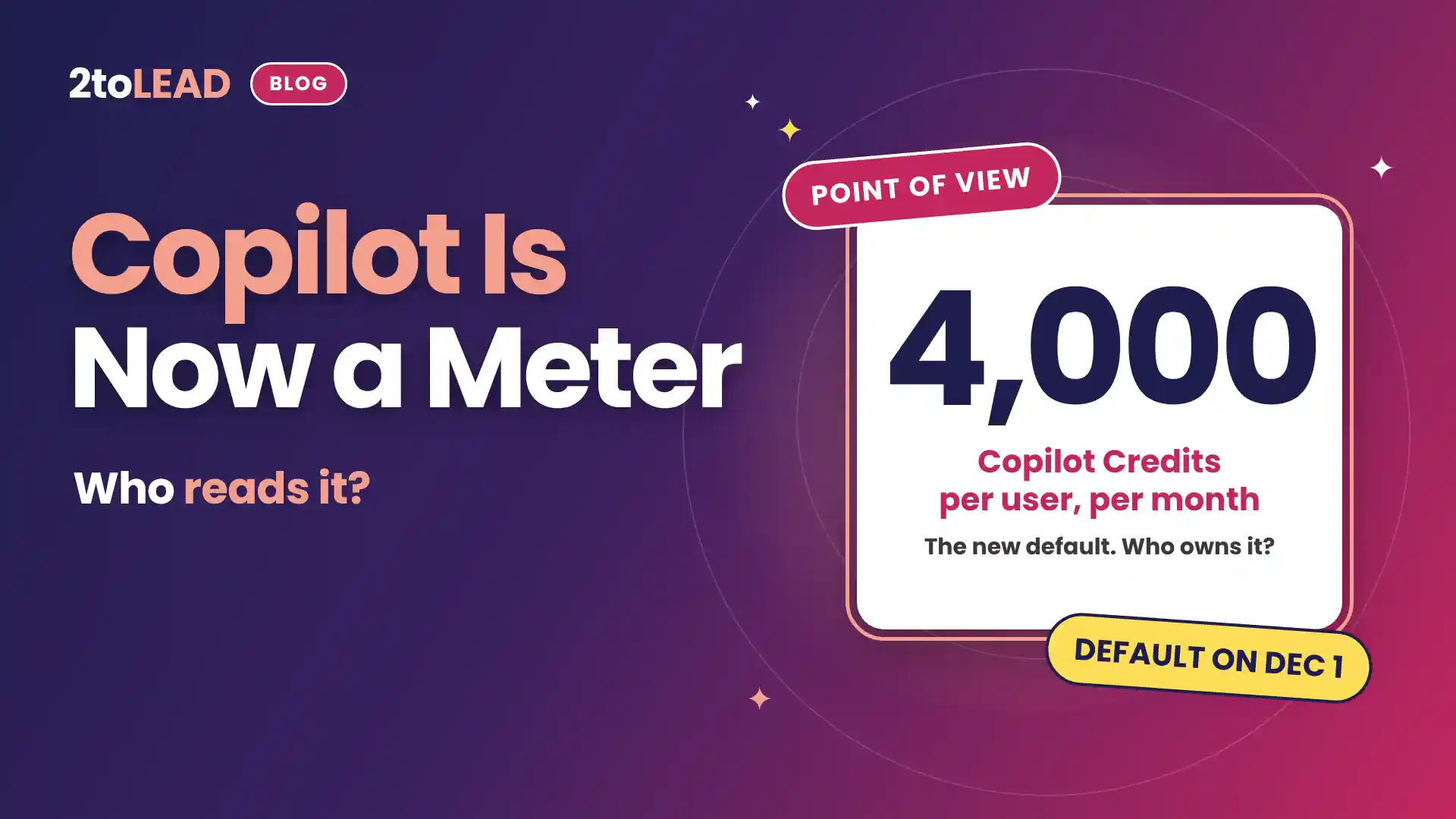
TL;DR: Copilot Credits turn Microsoft 365 Copilot from a seat you buy once into a meter that runs every day. From December 1, 2026, new Copilot Business licenses bought through partners arrive with usage-based billing switched on and a default limit of 4,000 Copilot Credits per user per month. The organizations that win will give every meter a business owner, not just an admin setting.
Copilot is no longer a license decision. It is a metering decision, and most organizations have not decided who reads the meter. For two years, the boardroom conversation was about seats. Microsoft now splits Copilot into a user subscription license for everyday AI and usage-based billing with Copilot Credits for advanced AI, including Copilot Cowork, Code, Autopilot, Work IQ APIs and frontier models. The seat buys access. The credits measure work.
Our position is simple. Treat Copilot Credits as a shared utility and you will overspend quietly or lock them down. Treat them as a business budget with a named owner, and the meter becomes Copilot's best ROI instrument.
If you need the licensing details first, our guide to the Microsoft 365 Copilot licensing changes on December 1, 2026 covers the dates and offer names.
Copilot Credits are the unit Microsoft uses to measure and bill advanced AI work in Microsoft 365 Copilot, separate from the per-user license. Long-running agent work, delegated tasks in Copilot Cowork, apps built with Copilot Code, Work IQ API calls and frontier models draw down credits. Everyday chat and Copilot in Word, Excel, PowerPoint, Outlook and Teams stay under the user license. If you are unsure which experience a task needs, our comparison of Copilot Chat vs Cowork vs Code vs Autopilot maps each one to the right kind of work.
Three facts from Microsoft shape everything that follows:
Microsoft's official overview, Understand usage-based billing and cost management for Copilot Credits, explains the mechanics. The mechanics are the easy part.
A seat is a one-time decision with a predictable cost. A meter is a continuous decision with a variable cost, and continuous decisions need an owner who is close to the work. That is the shift most organizations have not made yet.
Under a seat model, IT could own Copilot end to end. Under a metered model, every credit is a small business decision: was this Cowork task worth running, should this agent run hourly, does this team need a frontier model? IT cannot answer those questions. The finance lead, the HR director and the operations manager can.
Microsoft is already pushing visibility toward the business. Cost management insights in Microsoft Viva are enabled by default, so managers can see Copilot Credit usage for their teams, and spending policy names can be visible to a manager when a direct report uses that policy. The data is arriving in managers' hands whether or not anyone has asked them to own it.
In practice, the controls usually exist; what is missing is one person who owns the outcome and the spend. Here is a composite from our recent Copilot readiness work, anonymized and simplified. An operations team piloted Copilot Cowork to assemble a monthly board pack. It worked. Hours dropped, and the team asked to extend it to weekly client reporting. Then finance asked about a new Azure line item, IT asked who approved the extra users, and the operations director asked whether the weekly reports were worth the cost. Nobody could answer all three: an admin had set up the policy with a generic name and an all-users scope.
Nothing went wrong technically. That ownership gap is the pattern we see most often, and it is the same gap behind the agent sprawl that has become the new shadow IT.
Capping credits at zero is the strongest counter-argument. Metered AI is new, prices change quickly, and a zero cap guarantees no surprise invoice, so many CIOs will be tempted to switch usage-based billing off on December 1.
Our answer: a zero cap does not remove the cost, it moves it. Copilot Cowork and Work IQ APIs require usage-based billing, so your seats keep paying for everyday features while the highest-return work stays off, and teams find routes outside your governance.
The better default is a small, owned allowance: named pilot groups, limits well below Microsoft's default, an outcome for each policy, and wider access only once the outcome is proven. It is more work than a zero cap, and the only approach that produces evidence.
Leaders should treat each Copilot spending policy as a business budget with an owner, a limit and a measured return. Five moves make that real:
A Copilot spending policy is ready to grow when it has clear access, a deliberate allowance, a named owner and measured return. Use this scorecard before you widen any policy; if a row is blank, it is not ready.
Swipe horizontally to see each layer of the scorecard.
| Layer | The question | What good looks like |
|---|---|---|
| Access | Who holds a Copilot license and which experiences need credits? | Licensed users mapped to the advanced experiences they actually need, such as Cowork or Work IQ APIs |
| Allowance | Which spending policy covers them, and how much can they use? | A scoped policy with a deliberate monthly limit, alert thresholds and a confirmed paying subscription |
| Accountability | Who owns the outcome and the spend together? | A named business owner, a named admin and a monthly review date written on the policy record |
| Return | What did the credits buy? | A baseline and a monthly measure: hours returned, cycle time or volume delivered, set against credits and license cost |
Measure one workflow before and after, put a dollar value on the time returned, and compare it with what the policy spent. A simple, illustrative example: a 10-person finance team spends 6 hours each assembling a monthly close package. With a Cowork task doing the assembly, it drops to 2 hours. That is 40 hours a month. At a loaded cost of $80 an hour, the workflow returns about $3,200 a month. If monthly credit spend sits well below that, widen the policy; if not, fix the task or retire it. Use your own numbers and actual consumption from the Cost Management dashboard.
A metered model finally lets you connect a specific AI cost to a specific result.
No. Microsoft's model keeps everyday AI, including Copilot Chat and Copilot in Word, Excel, PowerPoint, Outlook and Teams, under the user subscription license. Advanced AI, such as Copilot Cowork, Work IQ APIs, Code, Autopilot and frontier models, uses Copilot Credits through usage-based billing.
New Microsoft 365 Copilot Business licenses purchased through Cloud Solution Provider partners arrive with usage-based billing enabled by default and a default limit of 4,000 Copilot Credits per user per month, which admins can adjust. Microsoft says the change initially excludes some markets. Existing subscriptions do not need any action.
Admins configure spending policies, but each policy should have a business owner who is accountable for the outcome it pays for. IT owns the controls, finance owns the budget, and the business owner decides whether the result is worth the spend.
2toLead helps organizations in healthcare, nonprofit, education, financial services, professional services, government and manufacturing turn Copilot spend into measurable outcomes. In a fixed-scope, three-week Copilot Credit Governance Sprint, our Microsoft MVP team will:
Find more practical guidance on the 2toLead Insights hub, or talk to our team about a Copilot Credit Governance Sprint.
No hype. Just practical, governed AI that actually gets adopted.


Join Our Newsletter