What Happens When the Standard Only Lives in Someone's Head?
Every vendor professional services agreement was read end to end, clause by clause, by legal counsel, with preferred and fallback positions applied from memory and prior deals rather than a written standard.
That worked. It just didn't scale.
Three constraints capped the team, not the demand
- Reviewer dependency. Review depth and turnaround shifted with whoever picked up the agreement and how full their queue already was. Capacity was set by calendar, not by demand.
- Sequential handoffs. Legal, IT, information security and supply chain each reviewed in turn, stretching one cycle across four departments.
- Low defensibility. Findings were rarely traceable back to a stated standard, which made decisions harder to explain, or defend, later.
The goal was never to replace legal judgment. It was to make that judgment consistent, explainable and repeatable, so experts spend their time on the exceptions instead of the first pass.
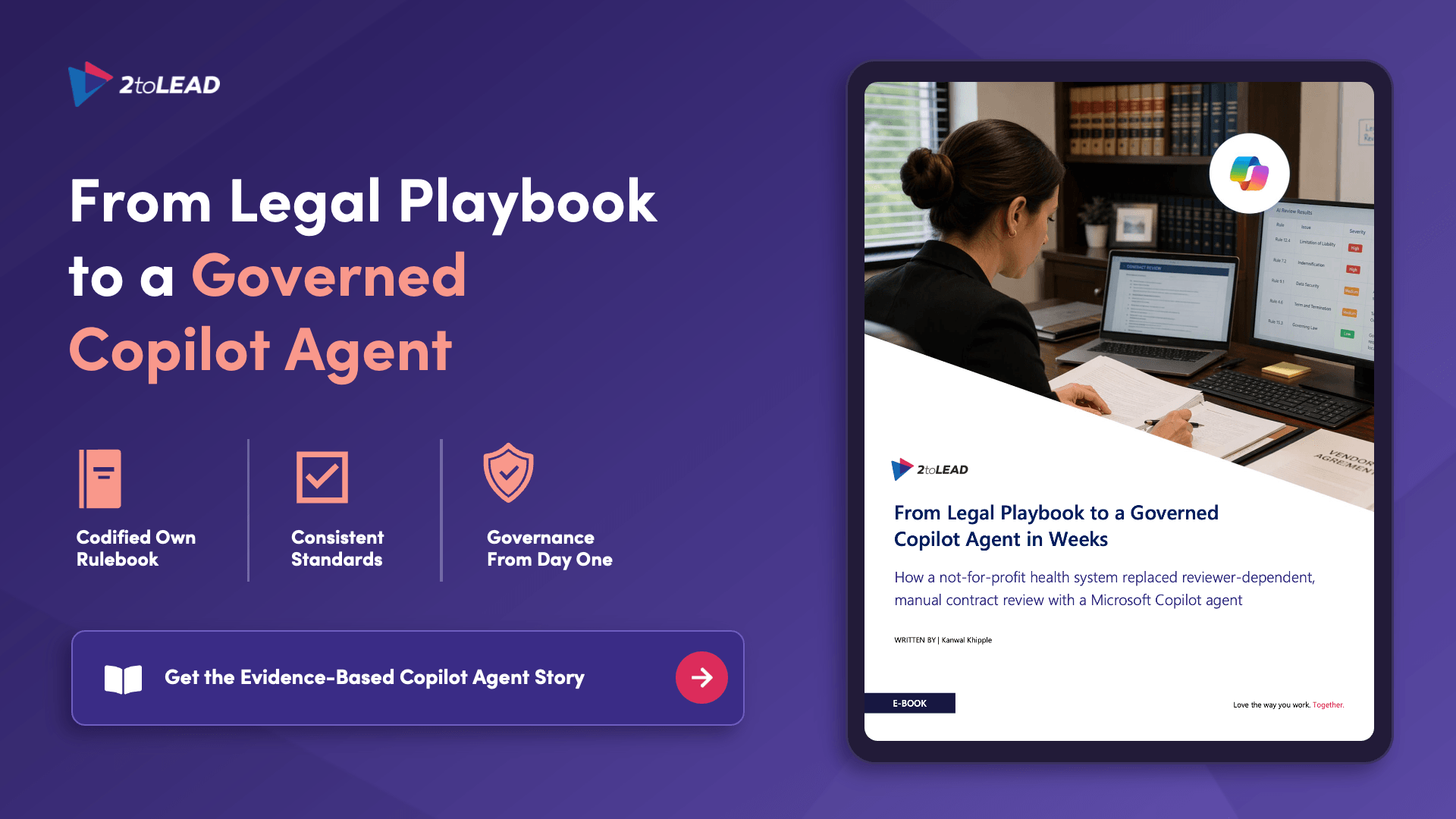
What You'll Uncover Inside This Copilot Agent Case Study
- The step before the build. Why the team wrote the rulebook first,. and why that, not the model, is the asset the client now owns
- The architecture call that made it explainable. Two Copilot Studio approaches were built and compared head-to-head. Only one survived the testing. The case study explains what tipped it
- What "governed" actually required. The environment, publishing and spend-control decisions that separated this from a sandbox experiment
- How trust was earned before go-live. The validation volume behind three major revision rounds and what failed the first time
- The human-in-the-loop design that made an AI agent adoptable in a regulated healthcare setting, where nothing changes without a reviewer accepting it
- What legal asked for next and why the answer didn't require a rebuild
Who Should Read This Case Study
- Technical Owners & Makers designing agent architecture and validating tenant readiness before the first production agent ships
- Legal, Risk & Compliance Leaders who need AI output to be traceable, reviewable and defensible
- CIOs & IT Decision-Makers deciding how agents get built, approved, published and paid for without creating sprawl
- Operations & Shared-Services Leaders sitting on a high-volume workflow that still depends on who's available
Get the Full Case Study
Download your free copy now. The rulebook method, the architecture decision, and the governance path, in one read.