Welcome to this month's edition. Everyone can access Copilot but far fewer can prove it's working. In this issue, we tackle the exact moment most rollouts stall, share hard-number proof that adoption pays off, and give your leaders and champions the playbook to scale Microsoft 365 Copilot responsibly. Let's dig in. 👇
The fastest path to Microsoft 365 Copilot adoption isn't more licenses, it's culture. An AI-ready culture is one where employees feel confident, supported, and curious about using AI in their daily work, and Microsoft's 2026 Work Trend Index backs this up: organizational factors like culture and manager support carry roughly twice the predictive power of individual mindset when measuring AI impact.
This piece breaks down how communicators and change leaders can set the tone, lead with real-role scenarios instead of features, and use "adoption hotspots" to reach the right people with the right message.
Read it: Building an AI-Ready Culture for Copilot
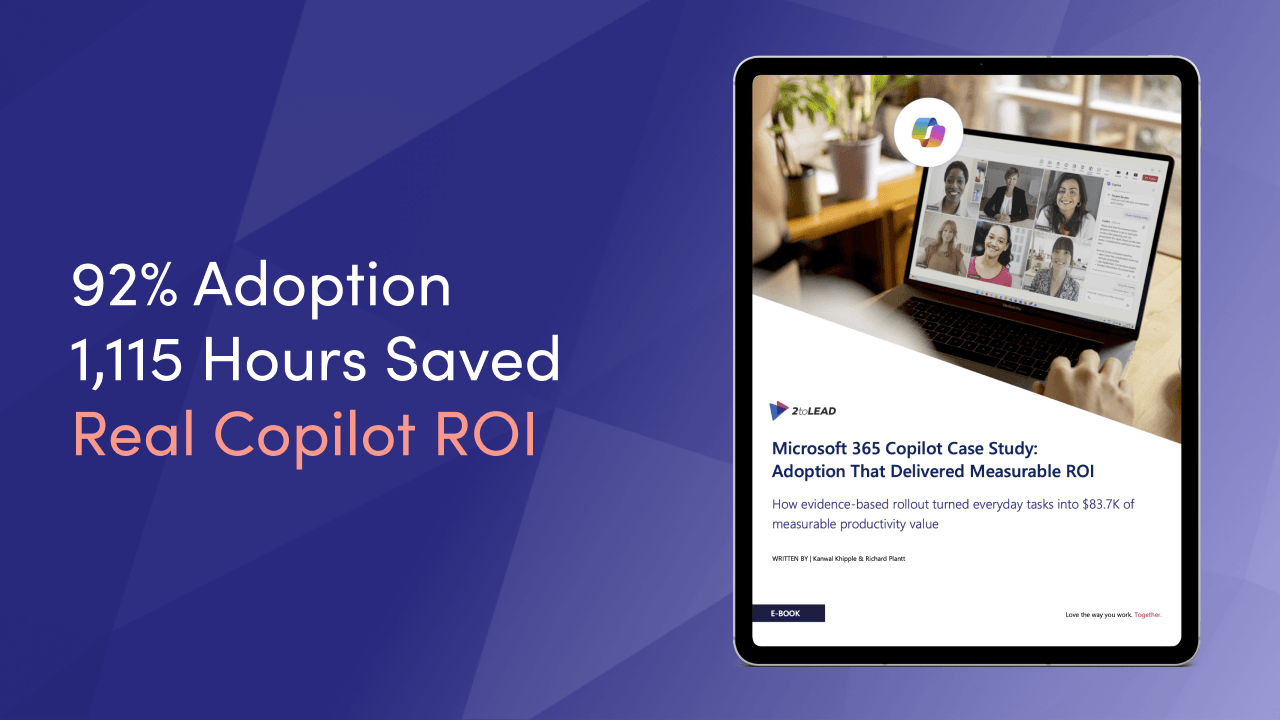
When your CFO asks, "is Copilot actually working?", this is the answer. See how 2toLead helped a global nonprofit turn Copilot licenses into 1,115.6 hours saved, $83.7K in productivity value, and a 4.5-month payback, with the evidence leadership needed before scaling. If you're building a business case for renewal or expansion, this is the proof point to share.
Read the case study: Microsoft 365 Copilot Case Study: Adoption That Delivered Measurable ROI

If your only answer to "Is Copilot working?" is an active-user percentage, you're measuring the wrong thing. Active users is a vanity metric. This new piece breaks down the four dimensions that actually prove value (activation, engagement, productivity, and business impact) and the KPIs inside each, so you can walk into any leadership conversation with evidence.
Read it: Beyond "Active Users": The Copilot Adoption Metrics That Actually Prove Value

Most Copilot deployments stall between weeks 6 and 12. Early enthusiasm fades, usage goes uneven, value gets hard to prove, and no one clearly owns the change. The fix isn't another "what is Copilot" explainer, it's a real plan to move from "we're adopting Copilot" to "we have a system that keeps adoption growing."
This month we're spotlighting the shift from stalled pilots to scaled, governed adoption, and how a structured approach (champions, measurement, and role-specific enablement) breaks through the wall.
Explore how to break through: The Copilot Governance Gap in 2026: Why Deployments Stall and How to Close It
Copilot doesn't transform a team by being switched on, it transforms them when HR stops drowning in admin, Finance closes faster, and Sales walks into every call prepared. This new blog gets specific with the repeatable, role-based workflows that drive real adoption. It's the real-world playbook for turning "we have Copilot licenses" into "here's how our teams actually work now."
Read it: Copilot for HR / Finance / Sales: The Everyday Workflows That Actually Change How Teams Work
Knowing the workflows is step one. Rolling them out so they actually stick is where the real transformation happens, and that rarely comes from a template. It comes from workflows built around how your HR, Finance, and Sales teams already work. Whether you're preparing your first pilot or scaling Copilot across the business, our team can help you turn everyday wins into lasting, organization-wide change.


Join Our Newsletter