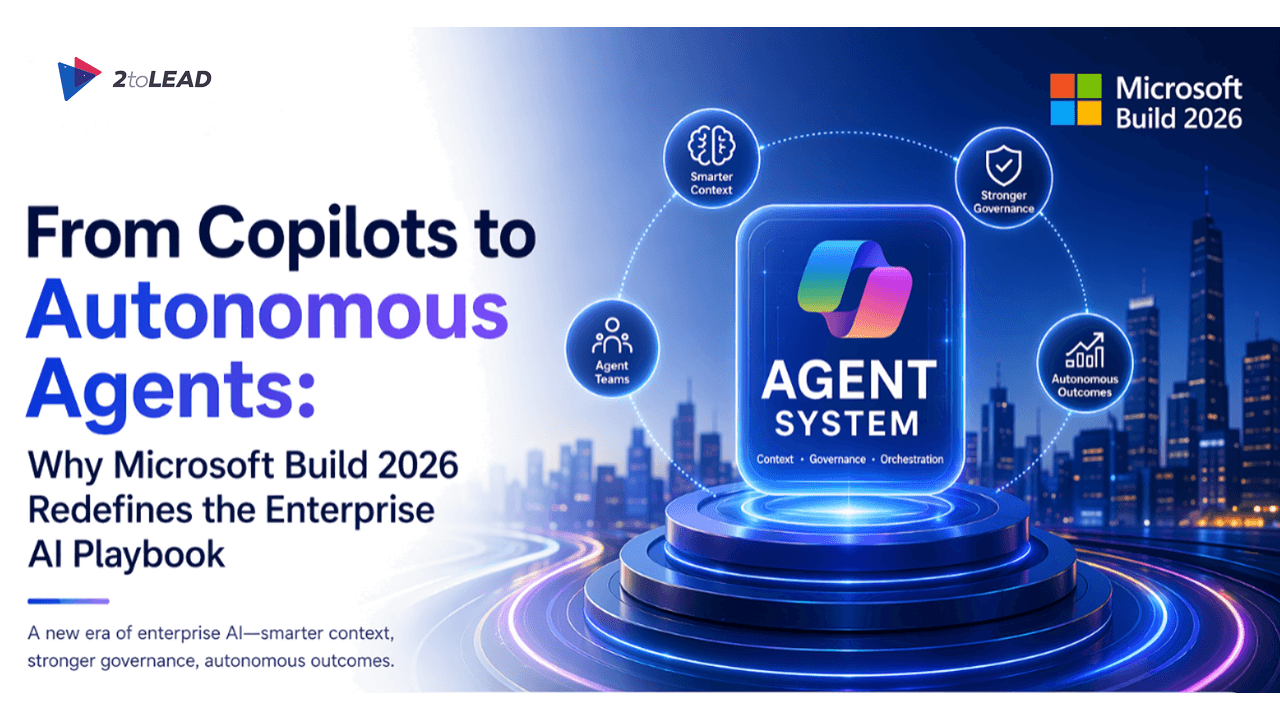
For the last two years, "Copilot" has been the headline. At Microsoft Build 2026, that headline quietly changed. The conversation is no longer about assistants that help a human finish a task - it's about autonomous agents that do the work end-to-end, governed by enterprise policy, grounded in enterprise context, and orchestrated across teams of other agents.
This is the shift 2toLead has been preparing clients for through our Agent Accelerator and Copilot ROI engagements. Below is what changed at Build 2026, why it matters, and how IT, EX, and governance leaders should respond in the next two quarters.
Microsoft framed Build 2026 around a single thesis: every layer of the AI stack should be agent-native. Copilot is evolving into a "super app" that spans chat, M365 apps, code, and the browser, but underneath it is a new operating model where agents have memory, identity, governance, and the ability to run for hours or days without supervision.
Five announcements stood out. Together, they form the blueprint for what enterprise AI looks like in 2026 and beyond.
The most strategically important announcement is Microsoft IQ, the unified intelligence layer that gives agents the same situational awareness a senior employee has on day 365, not day 1.
Microsoft IQ is the umbrella. It connects how people work, how the business operates, and how agents unlock knowledge, through four interconnected pillars:
Live understanding of how employees work: people, collaboration, meetings, chats, files, and workflows across the Microsoft 365 trust boundary. This is the layer that powers Microsoft Scout.
The semantic layer over your structured business data in OneLake and Power BI. It teaches agents what "customer," "order," or "region" mean in your company's language — so every agent reasons about data the same way.
Managed, permission-aware knowledge retrieval that unifies your sources behind one endpoint, purpose-built for enterprise agents in Microsoft Foundry (Azure AI Foundry).
Agent-native web grounding, so agents can browse, reason, and cite the open web safely with fresh, real-world intelligence.
Why it matters: Most failed Copilot pilots fail for one reason, the model didn't have the right context. The IQ stack is Microsoft's answer. For 2toLead clients, this is the moment to revisit your information architecture, SharePoint Premium investments, and Purview labeling strategy. Agents are only as smart as the context they can reach, and as safe as the governance around it.
If 2024–2025 was the era of "shadow Copilots," Agent 365 is the antidote. It's the control plane for the enterprise agent estate, discovery, identity, lifecycle, monitoring, and policy enforcement for every agent in your tenant, whether it's built in Copilot Studio, Microsoft Foundry, or a third-party framework.
A quick note on timing, because your CISO will ask: Agent 365 was introduced at Ignite 2025 and reached general availability on May 1, 2026. What shipped at Build 2026 was the Agent 365 SDK, letting developers compile its access controls, compliance, and observability hooks directly into their own agents, plus the Agent Orchestrator service in preview.
For CIOs, CISOs, and risk leaders, this changes the conversation from"Should we allow agents?" to"How do we operate a fleet of them?" Agent 365 maps directly to the governance pillar of the 2toLead Agent Accelerator: inventory, classify, govern, measure.
Microsoft introduced one genuinely new category of agent at Build 2026: Autopilots: always-on agents that work autonomously, carry their own identity, and act on your behalf within the permissions and policies you set.
It's an always-on personal work agent that:
Autopilots are designed to take on multi-hour or multi-day initiatives, a migration, a campaign, a quarterly close, with checkpoints rather than constant prompts.
Why it matters for EX leaders: Productivity measurement shifts from"prompts per user" to"outcomes delivered per agent." Adoption strategies must now plan for human–agent collaboration patterns, not just training people on chat.
Want the deeper dive? See our companion article: What Is Microsoft Scout? The Always-On Autopilot Agent for Microsoft 365
Single agents are giving way to teams of agents. Microsoft's orchestration services let you compose specialists, a researcher, a writer, a reviewer, an approver, and let them collaborate under a supervising agent.
This is the architectural pattern 2toLead has recommended in our Agent Accelerator workshops all along: start with a process, decompose it into roles, and assign each role to a purpose-built agent. Build 2026 makes this the default, not the exception.
Several announcements signal Microsoft's commitment to an open, multi-model agent ecosystem:
For architects, this is the end of single-vendor lock-in fear. You can standardize on Copilot as the experience layer while keeping model choice flexible underneath.
The takeaway from Build 2026 isn't "buy more AI." It's "operate AI like a workforce." Here's where to start in the next two quarters:
Microsoft IQ is the unified intelligence (context) layer announced at Build 2026 that gives Microsoft 365 Copilot and AI agents a shared, continuously updated understanding of your organization. It has four pillars: Work IQ, Fabric IQ, Foundry IQ, and Web IQ.
No. Copilot is largely reactive, you prompt it, it responds. Scout is an Autopilot agent: it's always-on, works in the background with its own Entra identity, and takes multi-step action without being prompted each time.
Autopilots are a new category of always-on, autonomous agents introduced at Build 2026. They operate with their own governed identity, act within the permissions you set, and carry long-running work forward with checkpoints rather than constant prompts. Microsoft Scout is the first Autopilot.
Agent 365 reached general availability on May 1, 2026. At Build 2026, Microsoft shipped the Agent 365 SDK (so developers can bake governance and observability into their own agents) and previewed the Agent Orchestrator service.
A Copilot assists a human completing a task in real time. An AI agent completes work end-to-end, grounded in enterprise context, governed by policy, and capable of running autonomously and collaborating with other agents.


Join Our Newsletter