AI agents are moving fast from experimentation to production. Across Microsoft 365 Copilot, Copilot Studio, Microsoft Foundry, SharePoint, Teams, Dataverse, and enterprise systems, organizations are building agents to answer questions, automate workflows, support decisions, and reduce manual work.
But here’s the uncomfortable truth: AI agents rarely fail because the model cannot respond. They fail because the enterprise around the agent is not ready.
Without clear ownership, trusted data, permission-aware access, security controls, evaluation criteria, cost discipline, observability, and lifecycle governance, even a promising pilot can turn into agent sprawl.
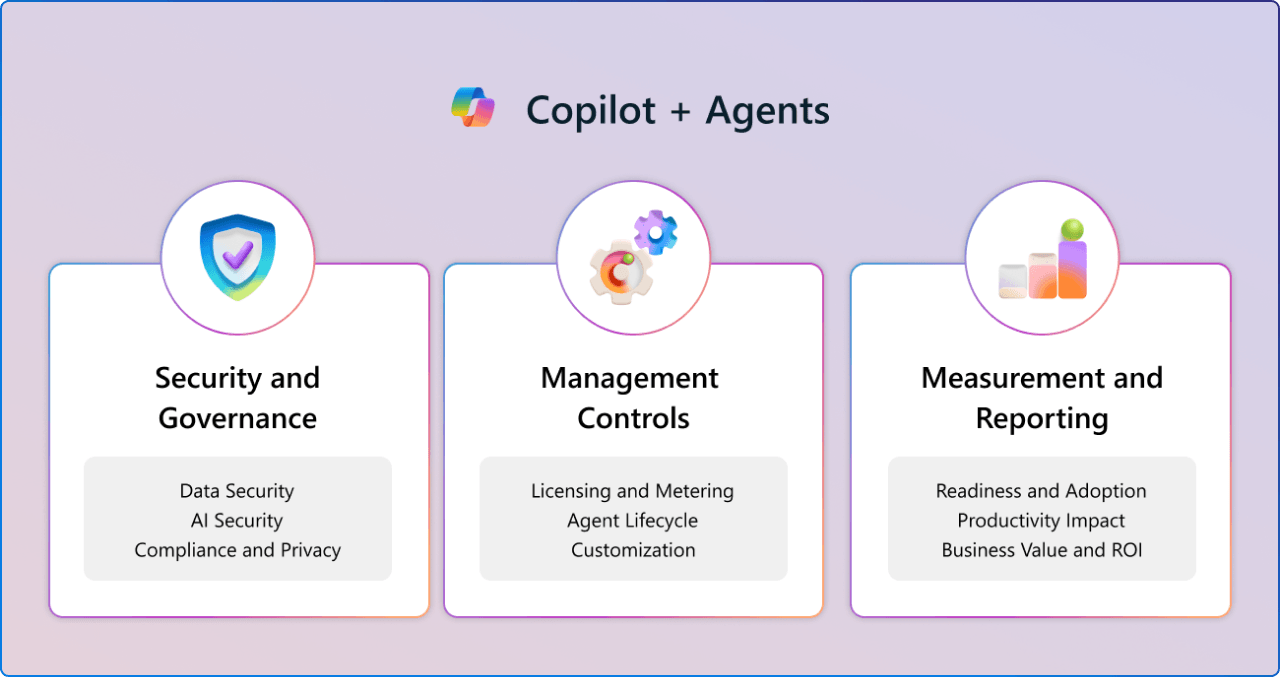
Microsoft’s guidance on AI agent governance emphasizes that agents introduce organizational risk because they can access data, take actions, and operate with delegated authority, making visibility, ownership, access control, and observability essential.
Before your next agent moves from prototype to production, watch for these seven failure patterns.
Many enterprise AI agent projects start with excitement but lack accountability.
The agent may have a use case, but no clear business owner. No one has defined the measurable outcome, success criteria, risk tolerance, or long-term value. That makes it difficult for CIOs, CTOs, Chief AI Officers, and digital transformation leaders to prove ROI or justify scale.
For CIOs, CTOs, Chief AI Officers, and digital transformation leaders, AI agent success must connect to measurable business outcomes. Without that connection, it becomes difficult to prove ROI, prioritize use cases, or defend the next wave of investment.
AI agents are only as trustworthy as the data they can access.
If SharePoint, Teams, OneDrive, Dataverse, or connected knowledge sources contain stale, duplicated, overshared, or poorly governed content, your agent can surface inaccurate, risky, or overexposed information.
Microsoft’s Copilot Control System guidance highlights new and amplified risks around security, compliance, privacy, and governance when implementing Microsoft 365 Copilot and agents. It also recommends using Microsoft Purview and SharePoint Advanced Management to assess oversharing risks and protect sensitive data.
For CISOs, compliance leaders, data governance teams, and Microsoft 365 platform owners, this is one of the biggest AI readiness risks. AI does not create every data governance issue, but it can expose them faster.
The risk level changes when an AI agent moves from answering questions to taking action.
Enterprise agents may call APIs, trigger Power Automate flows, connect to Dataverse, update records, create content, or act on behalf of users. Without governance, those actions can create security, compliance, and operational risk.
Microsoft guidance warns that without a unified development process, organizations can experience uncontrolled agent sprawl, inconsistent architectures, and critical security gaps.
For IT, platform, architecture, and security teams, tool access is not a minor configuration detail. It determines what the agent can actually do inside the enterprise.
A working demo is not the same as a production-ready agent.
Many AI agents perform well in a controlled pilot but fail when exposed to real users, messy prompts, incomplete data, unclear requests, tool failures, latency, edge cases, or changing business context.
Enterprise AI agents need more than acceptance testing. They need ongoing evaluation.
Teams should know whether the agent gives grounded answers, uses tools correctly, handles exceptions, escalates appropriately, and improves over time.
A successful demo does not mean the agent is ready for real users.
Many AI agents perform well in controlled pilots but fail when they encounter messy prompts, edge cases, poor data, tool failures, latency, unclear instructions, or unexpected user behavior.
Enterprise AI agents need more than acceptance testing. They need ongoing evaluation.
Teams should know whether the agent gives grounded answers, uses tools correctly, handles exceptions, escalates appropriately, and improves over time.
AI agent costs are not limited to model usage.
They can include licensing, Azure consumption, token usage, search and indexing, storage, telemetry, integrations, governance, support, evaluation, training, and ongoing optimization. If those costs are not tied to business value, AI programs become difficult to justify.
For executives, CFO-facing sponsors, and AI portfolio owners, cost discipline is part of AI governance.
Organizations need to know which agents are worth scaling, which need redesign, and which should be retired.
The biggest AI agent risk is not one failed pilot. There are dozens of disconnected agents spreading across the organization without a shared operating model.
This is how agent sprawl begins.
Different teams create agents independently. Some connect to sensitive data. Some use overlapping workflows. Some are abandoned after launch. Some continue running without clear ownership. Over time, the organization loses visibility and control.

Microsoft’s governance guidance recommends centralized agent identity, consistent policy enforcement, unified inventory and ownership, continuous behavioral visibility, and cross-platform governance oversight for AI agents.
For enterprise leaders, this is the shift from AI experimentation to AI operating model. The goal is not to block innovation. The goal is to make AI agent adoption secure, measurable, repeatable, and scalable.
If any of these risks sound familiar, your next step is not to build faster, it is to align better. AI agents can create real enterprise value but only when the organization around them is ready.
Use 2toLead's AI Agent Readiness Checklist to assess whether your organization has the business ownership, security controls, data readiness, cost model, operational support, and governance foundation needed to scale AI agents responsibly.
Find out your organization's readiness score today:


Join Our Newsletter