By clicking “Accept”, you agree to the storing of cookies on your device to enhance site navigation, analyze site usage, and assist in our marketing efforts. View our Cookie Policy for more information.
Icon Rounded Closed - BRIX Templates

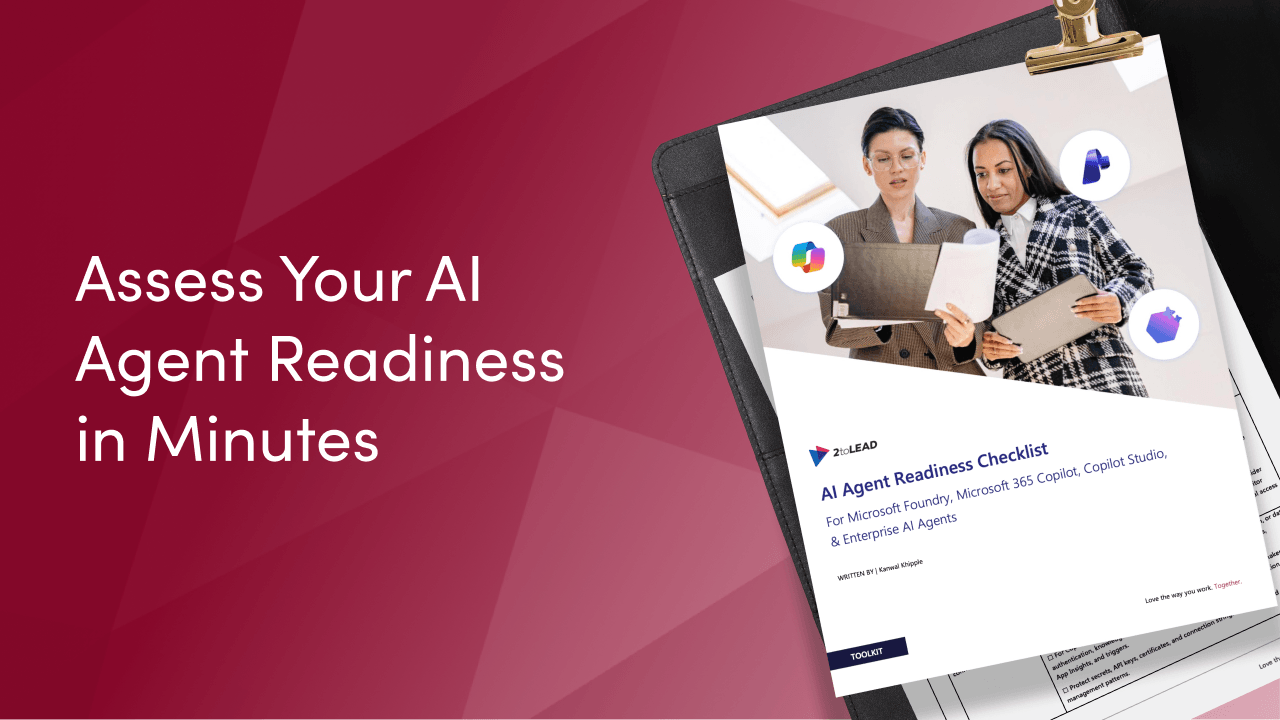
AI Agent Readiness Checklist

AI agents are moving from experiments to everyday work but is your organization ready to scale them securely? Use this checklist to assess your readiness across security, governance, data, performance, cost, and operations before agents reach production.
Kanwal Khipple

Move From AI Agent Experiments to Secure, Scalable Adoption

AI agents are moving from demos to real work, but most organizations still need stronger foundations before they scale.

This practical checklist helps your team assess whether your business outcomes, data, security, governance, operating model, and adoption plans are ready for enterprise AI agents across Microsoft Foundry, Microsoft 365 Copilot, Copilot Studio, and enterprise AI agent experiences.

Use it to identify gaps, align stakeholders, and decide your next best step before investing more time, budget, or executive attention into AI agent development.

What’s Inside the Checklist?

This toolkit gives you a practical readiness framework for evaluating whether your organization is prepared to design, deploy, govern, and scale enterprise AI agents.

  • A readiness checklist across 5 key areas: Security, Reliability, Cost Optimization, Performance Efficiency, and Operational Excellence
  • Security and governance prompts to help review identity, access, Microsoft 365 data security, tool permissions, auditability, and responsible AI controls
  • Production-readiness questions for testing, resiliency, human-in-the-loop controls, support ownership, monitoring, and phased rollout planning
  • An AI Agent Readiness Scorecard to help teams assess whether they are high risk, pilot-ready, production-ready, or ready to scale
  • Recommended next steps based on your readiness score, including assessment, prioritization, governance, pilot, and scale paths

Why AI Agent Readiness Matters

AI agent success is not just about building faster. It is about knowing what should be built, what data it can use, what actions it can take, who owns it, how it will be monitored, and when it is safe to scale.

This checklist helps teams:

  • Spot readiness gaps before agents reach production
  • Align business, IT, security, compliance, data, and adoption teams
  • Connect agent investments to measurable outcomes and operating discipline
  • Strengthen the governance model needed for Copilot and AI agent adoption
  • Move from scattered experimentation to a more trusted, repeatable agent strategy

Who Should Use This Checklist?

This checklist is designed for cross-functional teams responsible for moving AI agents from experimentation to trusted enterprise adoption.

  • Business and digital workplace leaders
  • Digital workplace leaders
  • IT and platform owners
  • Data and knowledge owners
  • Security, risk, and compliance teams
  • Change management and adoption teams

Get Your AI Agent Readiness Score Now

The organizations that succeed with AI agents will not be the ones that build the most demos. They will be the ones that know where they are ready, where risk remains, and what needs to be strengthened before agents become part of everyday work

Download the AI Agent Readiness Checklist to assess your current readiness and identify the right next step for secure, scalable AI agent adoption.

Last updated on:
July 7, 2026
Published on:
July 7, 2026
share on
Learn more
Right arrow icon

Access Your Checklist Now

Thank you, your submission request has been received.
Your resource is ready! 🥳
Access Resource
Oops! Something went wrong while submitting the form. Please make sure that all required fields have been filled in.

Similar resources

Check-out these other great resources.
Next steps
Have a question, or just say hi. 🖐 Let's talk about your next big project.
Contact us
Mailing list
Occasionally we like to send clients and friends curated articles that have helped us improve.
Close Modal