You cannot govern what you cannot see. For Microsoft 365 leaders, Shadow AI is quickly becoming a visibility problem.
Shadow AI in Microsoft 365 refers to AI-powered tools and agents that employees use without IT awareness or approval. These tools may improve productivity, but unmanaged usage can introduce risks such as data leakage, compliance violations, security vulnerabilities, and limited auditability.
In many organizations, Shadow AI is not intentional, it emerges naturally as employees experiment with AI-powered coding assistants, browser extensions, local agents, and automation tools to work faster. The problem is that these tools often operate outside existing governance frameworks, making them difficult for IT and security teams to detect, monitor, and control.
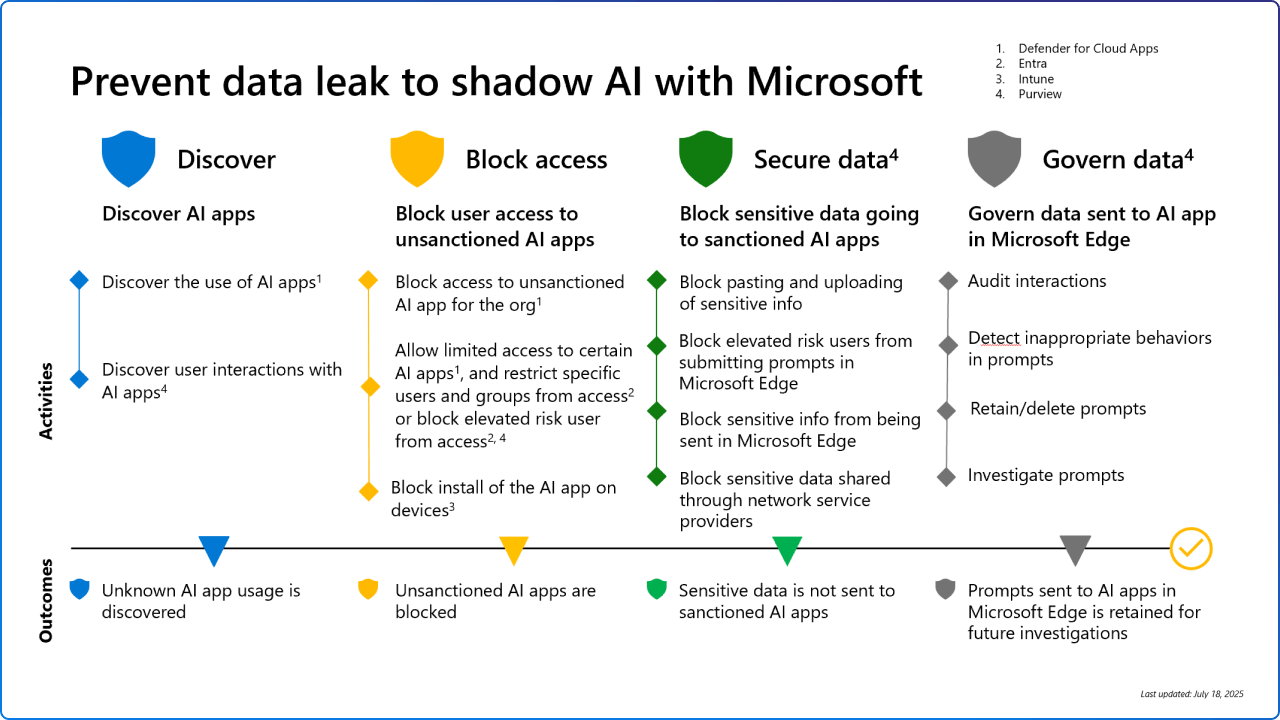
AI agents are not just passive tools, they can interact with files, execute workflows, connect to services, and act with user-level permissions. When deployed without oversight, they can introduce risks that traditional IT controls were not designed to handle.
Common Shadow AI risks include:
Unlike traditional Shadow IT, Shadow AI introduces a new layer of complexity: agents can act autonomously, interact with systems, and scale their impact quickly.

OpenClaw is identified by Microsoft as an example of an unauthorized AI coding assistant and one of the first Shadow AI agents supported for detection and blocking in the Microsoft 365 admin center (public preview).
This matters for two reasons:
1. It represents a broader category of tools
OpenClaw is not the risk itself, it is a signal. It represents local AI agents and coding tools that can:
2. It highlights a visibility gap
If one unmanaged AI agent can run on a corporate device without oversight, others likely can too.
For IT and security leaders, OpenClaw is less about one tool and more about what it reveals:
Unmanaged AI agents are already entering enterprise environments faster than governance models can adapt.
Microsoft provides a Shadow AI experience (currently in public preview) within the Microsoft 365 admin center to help administrators discover, monitor, and govern unmanaged AI agents.
This experience is designed to:
At the time of writing, Microsoft notes that:
This reinforces an important point: Shadow AI governance is not a one-time configuration, it is an evolving capability.
Agent sprawl happens when AI agents are created, installed, or adopted faster than IT teams can inventory and govern them.
OpenClaw illustrates how quickly this can happen:
The issue is not OpenClaw itself. The issue is that:
AI agents can become embedded into daily workflows before organizations establish the controls to manage them.
Without visibility, unmanaged AI agents risk becoming part of the organization’s hidden infrastructure.
Unmanaged AI agents can interact with sensitive files, business data, and code repositories, increasing the risk of data leakage or unauthorized access.
If an agent does not have a defined owner, purpose, or access scope, it becomes difficult to trace actions or assign responsibility.
AI agents often operate with the user’s permissions, which can lead to excessive access across systems, tools, and data.
When endpoint, security, compliance, and IT teams lack a unified view, decision-making becomes inconsistent and slower.

Shadow AI governance does not exist in isolation, it is part of a broader need to manage AI agents across the organization.
Microsoft positions Agent 365 as a control plane for observing, governing, and securing AI agents, while the Shadow AI experience focuses specifically on unmanaged agents operating without approval.
Before expanding AI adoption, organizations should focus on visibility and governance readiness.
Key starting points include:
Understand which tools or agents are already being used across the organization.
Ensure managed devices are enrolled and monitored through solutions like Microsoft Intune.
Every AI agent should have a clear owner, purpose, and access scope.
Integrate AI governance into current security, compliance, and cloud governance programs.
Discovery should come before blocking to avoid disrupting legitimate workflows.
The goal is not to stop innovation; it is to enable controlled, secure adoption of AI technologies.
Shadow AI is not just another version of Shadow IT. AI agents can:
That makes visibility and governance essential.
OpenClaw is an early example of how unmanaged AI agents can appear within enterprise environments. The Shadow AI experience in Microsoft 365 provides a starting point for detecting and governing this activity, but the broader opportunity is to build a governance model before adoption scales further.
For Microsoft 365 leaders, the next step is not to limit experimentation. It is to:
Here's the uncomfortable part: OpenClaw isn't the exception, it's the preview. For every agent you can name, there are others already embedded in daily workflows, quietly operating with your users' permissions.
Shadow AI doesn't announce itself. It sprawls.
What is Shadow AI in Microsoft 365?
Shadow AI refers to AI-powered tools and agents used without IT awareness or approval, which can introduce risks such as data leakage, compliance issues, and lack of governance.
What is OpenClaw?
OpenClaw is an unauthorized AI coding assistant identified by Microsoft and currently supported for detection and blocking in the Shadow AI preview experience.
Why is OpenClaw a Shadow AI risk?
OpenClaw is a Shadow AI risk as it represents a broader category of local AI agents that can access files, execute code, and operate without governance controls.
Can Microsoft 365 detect Shadow AI agents?
Yes Microsoft 365 can detect Shadow AI agents. In its current preview, Microsoft 365 supports detection and blocking of OpenClaw on managed Windows devices enrolled with Microsoft Intune.
What should organizations do before scaling AI agents?
Organizations should start with visibility, define ownership, and align AI governance with existing security and compliance frameworks before expanding adoption.


Join Our Newsletter