By clicking “Accept”, you agree to the storing of cookies on your device to enhance site navigation, analyze site usage, and assist in our marketing efforts. View our Cookie Policy for more information.
Icon Rounded Closed - BRIX Templates
Insights

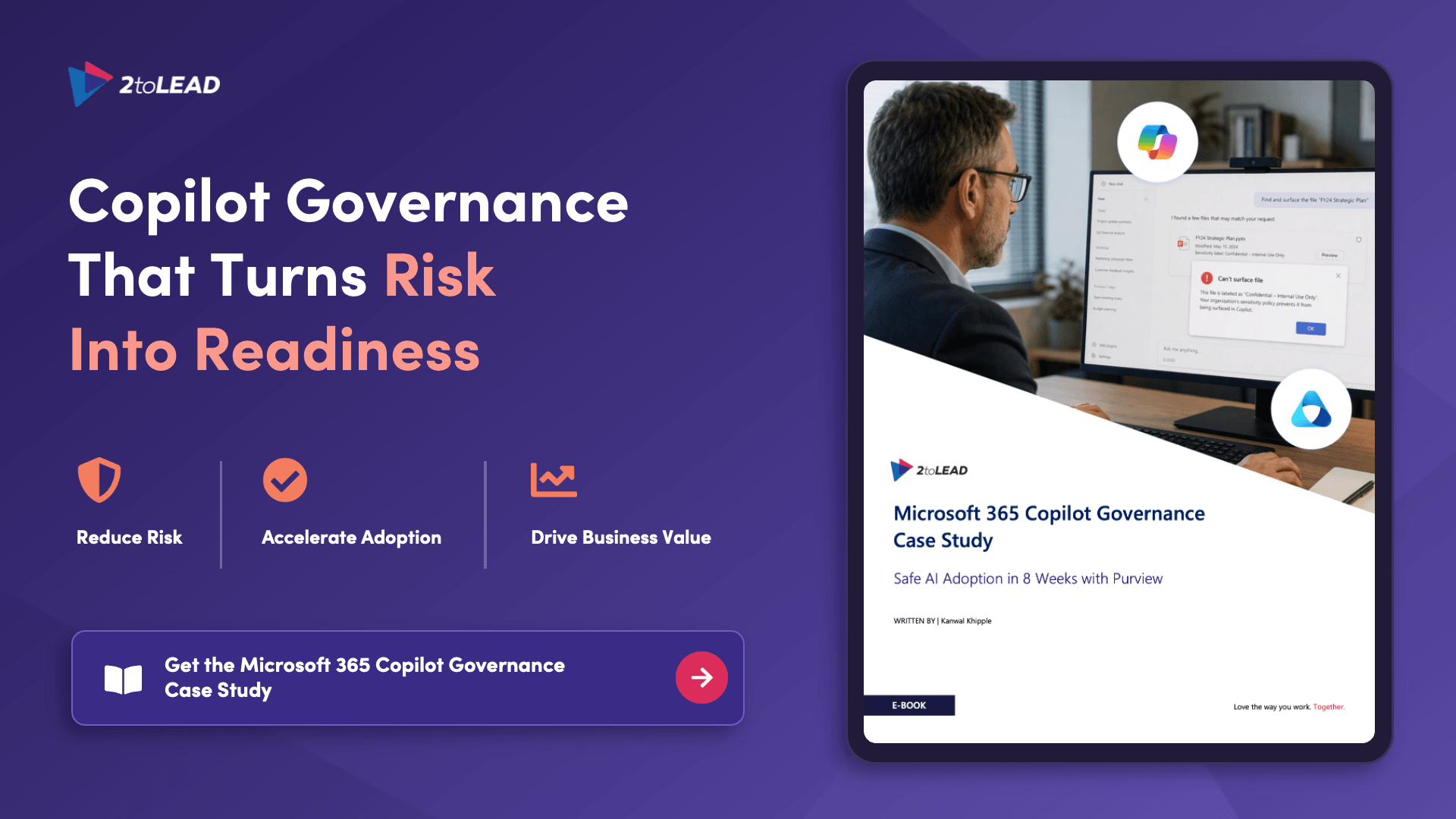
Secure Copilot Adoption in 8 Weeks: A Purview Governance Case Study

5 mins
share on
Secure Copilot Adoption in 8 Weeks: A Purview Governance Case Study

In ~8 weeks, 2toLead built a Zero Trust, Microsoft Purview–based governance foundation to adopt Microsoft 365 Copilot safely for a Canadian professional accounting and regulatory organization. The engagement remediated oversharing, deployed a 4-tier sensitivity label taxonomy, and enabled six Copilot DLP controls, proving that secure AI governance is the foundation that lets Copilot adoption scale faster, not slower.

Overview

A Canadian professional accounting and regulatory organization wanted the productivity of Microsoft 365 Copilot, without the risk of accidentally surfacing sensitive financial, member, or organizational records to the wrong people.

2toLead delivered a Secure AI & Governance engagement that reframed governance as a growth enabler: the foundation that lets AI adoption move faster, with better controls and stronger defensibility. This is Copilot governance done as strategic enablement, not an IT checkbox.

The Client Profile

  • Industry: Professional services - regulatory and membership body handling sensitive organizational and member information.
  • Size: ~11 to 50 employees
  • Environment: Hybrid Microsoft 365 and a legacy virtualized file share platform for corporate data, with cloud personal storage.
  • Baseline: Manual sensitivity labeling, premium identity governance capability, incumbent third-party endpoint protection, and native Microsoft security/compliance tooling.

The Challenge: The 2026 Copilot Oversharing Reality

Here's the industry context that makes this engagement matter: Copilot does not create oversharing risk, it exposes the oversharing that already exists. Because Copilot grounds its answers in the Microsoft Graph semantic index, a single natural-language prompt can surface any content a user already has permission to access.
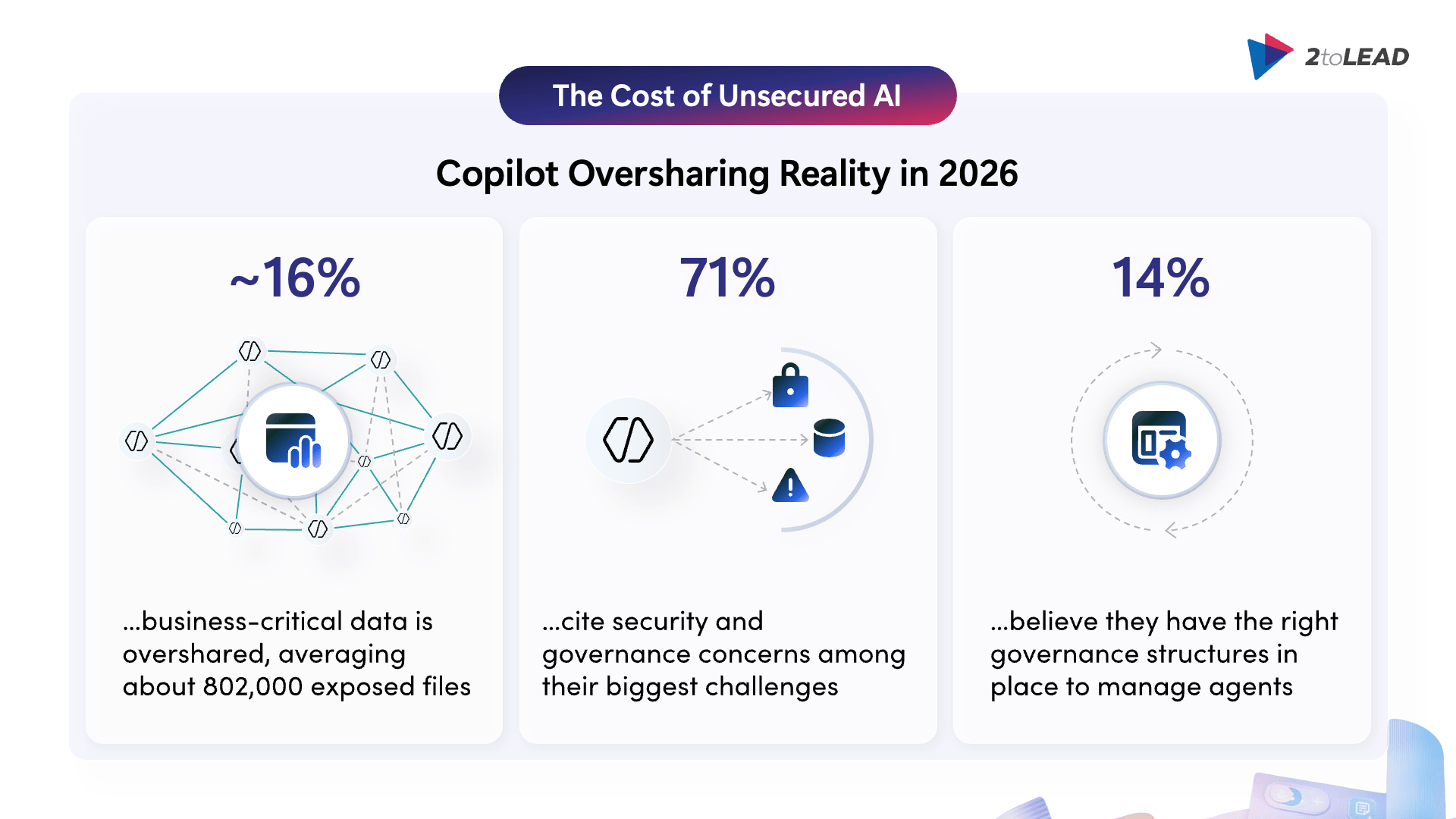
The cost of unsecured AI - Copilot oversharing reality in 2026

The stakes in 2026 are well documented:

  • ~16% of business-critical data is overshared, averaging roughly 802,000 exposed files per organization
  • 71% of technical stakeholders cite security and governance as their biggest challenge when adopting AI
  • Only 14% believe they have the right governance structures in place to manage AI agents today

Against that backdrop, the organization's own challenge was not unusual. The Microsoft 365 estate held real collaboration value, but years of organic growth had created permission sprawl, public collaboration spaces, owner gaps, stale content, and external guests, the exact conditions that turn Copilot readiness into Copilot risk.

When Copilot Readiness Becomes Copilot Risk
  • Oversharing: Several operational collaboration spaces were set to Public, meaning their content could be treated as open organizational knowledge.
  • Permission and ownership sprawl: The assessment found single-owner and ownerless workspaces, creating security and lifecycle management risk.
  • External guest sprawl: At least one active collaboration workspace had more than a dozen external guests, while another had several external guests.
  • Stale / test data: Old and test sites remained active, increasing the risk that Copilot could surface outdated or irrelevant records.
  • Shadow AI: The engagement identified the need to block unapproved third-party generative AI sites and prevent sensitive data from being pasted into public AI tools.
  • Compliance exposure: Monitoring showed that a small number of Copilot interactions contained sensitive data.

Why 2toLead: Building the Foundation, the Right Way

2toLead was selected to build the Microsoft 365 and Microsoft Purview AI governance foundation required for secure, effective Copilot adoption.

The engagement focused on using native Microsoft capabilities to establish endpoint visibility, data classification, access governance, and monitoring before scaling AI, a secure AI agent deployment approach that prioritizes defensibility over speed-at-any-cost.

The Solution: A Phased Path to Secure Copilot Adoption

Discover

The team finalized a four-tier sensitivity label taxonomy, clarified when to use Sensitive Info Types, Exact Data Match, and Trainable Classifiers, and validated label behaviour in the legacy file share environment.

A readiness report confirmed managed-device enrollment, an active endpoint-management connector, and active Rights Management Service, while noting that co-authoring for labelled files was disabled.

Pilot

Endpoint detection was configured in passive mode so the incumbent antivirus could remain primary while Microsoft tooling collected telemetry and DLP signals. Purview Unified Audit Logging, label policies, label validation, and simulation-mode auto-labeling supported a controlled rollout.

Production Rollout

Labels were published broadly, endpoint telemetry coverage was advanced, Copilot-specific DLP was reviewed, permission hygiene was assessed, and initial access reviews were configured for sensitive groups and locations.

Operational Controls: The Six Copilot DLP Policies

The DLP recommendation set included six custom Copilot data protection policies:

  • Blocking sensitive information in Copilot prompts
  • Restricting Copilot access to Highly Confidential content
  • Warning users when Copilot uses Confidential content
  • Preventing external sharing of Highly Confidential files
  • Blocking paste of labelled data into public AI
  • Restricting USB / print for Highly Confidential data

The Results

  • 4-tier sensitivity taxonomy deployed across cloud and legacy file share contexts.
  • ~5 public operational spaces identified for remediation.
  • 6 custom DLP policies recommended for Copilot and data security.
  • Quarterly owner-driven access reviews recommended for least-privilege governance.
  • Passive-mode endpoint telemetry approach designed to avoid disruption to incumbent protection.

The roadmap moved the organization toward final label deployment, shadow-AI blocking, an initial DLP pilot, access assessment remediation, a Copilot COE, Data Access Governance reports, and eventual migration of legacy fileshare data into governed cloud storage.

Key Takeaways

  • Governance enables AI velocity when it makes access, classification, and ownership clearer.
  • Copilot readiness depends on permission hygiene, because Copilot surfaces content through existing access.
  • Simulation-mode controls reduce adoption friction while preparing for enforcement.
  • Hybrid organizations can still make progress by pairing cloud-native protection with manual labeling patterns for legacy fileshare data.

Ready to Make Copilot Safe to Adopt?

  • Security posture review: identify what Copilot could surface in your tenant today.
  • Executive briefing: align leadership on AI risk, ROI, and the cost of inaction.
  • Copilot readiness assessment: prepare data protection, permissions, endpoints, and governance for secure AI adoption.

💬 Start the conversation →

Frequently Asked Questions

What does a Copilot governance foundation include?

A Copilot governance foundation includes a sensitivity-label taxonomy, endpoint telemetry, unified audit logging, Copilot-specific DLP recommendations, permission hygiene, and recurring access reviews. In this engagement, all six were delivered using native Microsoft 365 and Microsoft Purview capabilities.

Can Microsoft 365 Copilot leak sensitive data?

Microsoft 365 Copilot does not bypass permissions, it operates on each user's existing access. The risk is that if permissions are too broad, Public, stale, or unreviewed, that content can surface in AI-generated responses. Copilot exposes pre-existing oversharing rather than creating new access.

How long does a Copilot governance engagement take?

This Secure AI & Governance engagement was completed in approximately 8 weeks, covering discovery, pilot, and production rollout phases. Timelines vary with tenant size, data volume, and the maturity of existing permission and labeling practices.

What is the difference between Copilot readiness and Copilot adoption?

Copilot readiness is the governance groundwork, data classification, permission hygiene, DLP, and access reviews, that must exist before rollout. Copilot adoption is the rollout and change management that follows. Skipping readiness is the most common reason Copilot deployments stall between weeks 6 and 12.

How much data is typically overshared before a Copilot rollout?

Recent 2026 research indicates roughly 16% of business-critical data is overshared, averaging about 802,000 exposed files per organization. This is why a permissions and oversharing cleanup is considered non-negotiable before scaling Microsoft 365 Copilot.

Get a a Copilot governance framework & learn how to prioritize Microsoft Purview controls.
Case Study Details

Similar posts

Get our perspectives on the latest developments in technology and business.
Love the way you work. Together.
Next steps
Have a question, or just say hi. 🖐 Let's talk about your next big project.
Contact us
Mailing list
Occasionally we like to send clients and friends curated articles that have helped us improve.
Close Modal